Hungaria orbital region
The
Hungaria region is located at the inner edge of the asteroid main belt
(at semi-major axis a < 2 AU), and it is located at high
inclinations and low to moderate eccentricities. The limitations
in eccentricity allow for a perihelion large enough to avoid strong
interactions with Mars, even considering secular changes in the Mars
eccentricity. (Milani et al. 2010). The g-g3 and g-g5
secular resonances fix the dynamical limits of the Hungaria region in
inclination. Only one family has been so far positively identified in
the Hungaria orbital region, the namesake (434) Hungaria group by
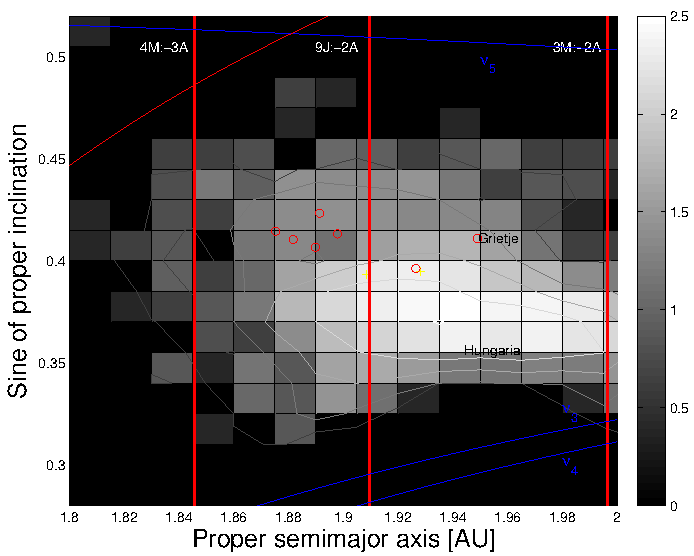
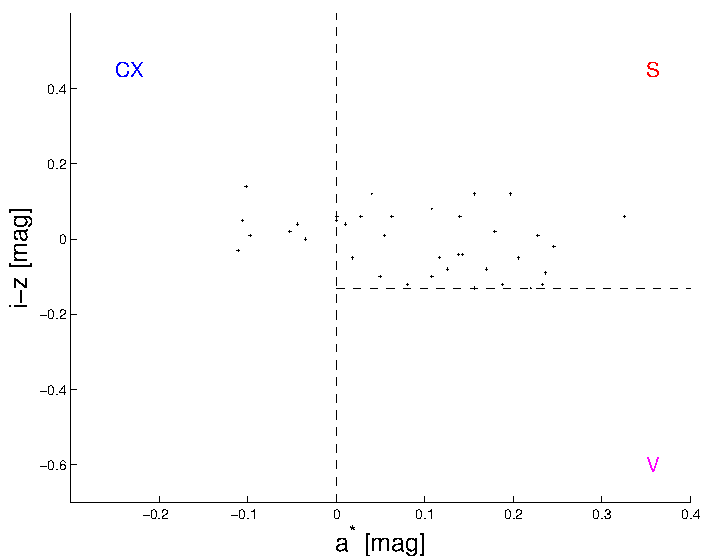
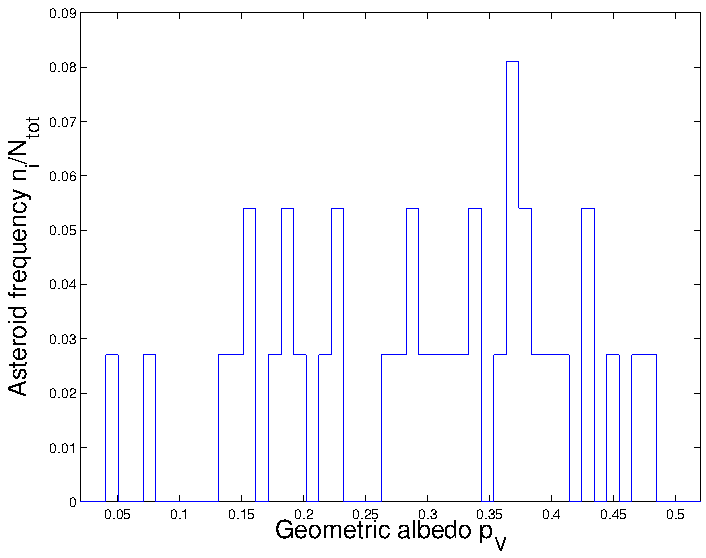
Milani et al. (2010). Other authors (Cañada-Assandri et al. 2013) pointed out that the highly inclined Hungaria population is dominated by S-type objects, and fairly distinguished from the C-complex population observed in the Hungaria dynamical family. But no family in proper elements domain has yet been observed in this highly inclined region. We identified only 37 objects in our multi-domain sample, with reasonable errors, and two possible families, reported in the table. Asteroids in the Hungaria region tend to have high albedo values, as shown in the Fig. 3.
Milani et al. (2010). Other authors (Cañada-Assandri et al. 2013) pointed out that the highly inclined Hungaria population is dominated by S-type objects, and fairly distinguished from the C-complex population observed in the Hungaria dynamical family. But no family in proper elements domain has yet been observed in this highly inclined region. We identified only 37 objects in our multi-domain sample, with reasonable errors, and two possible families, reported in the table. Asteroids in the Hungaria region tend to have high albedo values, as shown in the Fig. 3.
 |
 |
 |
| Contour plot of the number density of asteroids in the proper element sample. Superimposed, we display the orbital location of asteroids of families in the CX-complex (plus signs) and S-complex (circles). |
An (a*,i-z) projection of Hungaria-region asteroids in the in our multi-domain sample. |
A histogram of number frequency values ni/NTot as a function of geometric albedo pV for Hungaria-region asteroids in our multi-domain sample. |
| First halo member |
dmd [m/s] |
Number of members |
Spectral complex |
Number of SDSS-MOC4 interlopers |
Number of albedo interlopers |
| (434) Hungaria: (5968) |
590 |
2 |
CX |
1 |
2 |
| (2049) Grietje: (3043) |
655 |
7 |
S |
1 |
0 |