Outer main belt
The
outer main belt is dynamically limited in semi-major axis by the 5J:-2A
and 2J:-1A mean-motion resonances (Zappalá et al.
1995). The linear secular resonance g-g6 separates
the low-inclined asteroid region from the highly inclined area,
dominated by the Euphrosyne family (Machuca and Carruba 2011). We
found 5385 objects that have proper elements and frequencies, SDSS-MOC4
colors, WISE geometric albedo data, and satisfy our error analysis
criteria in the outer main belt.
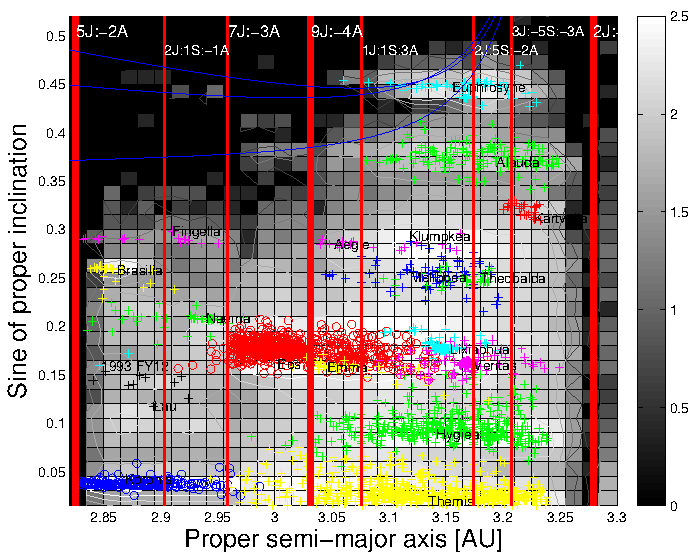
The great majority of asteroids in the region belong to the CX-complex, but there is a sizable minority of bodies belonging to the S-complex, that are mostly associated with the Eos and Koronis families.
The great majority of asteroids in the region belong to the CX-complex, but there is a sizable minority of bodies belonging to the S-complex, that are mostly associated with the Eos and Koronis families.
 |
 |
 |
| Contour plot of the number density of asteroids in the proper element sample. Superimposed, we display the orbital location of asteroids of families in the CX-complex (plus signs) and S-complex (circles). |
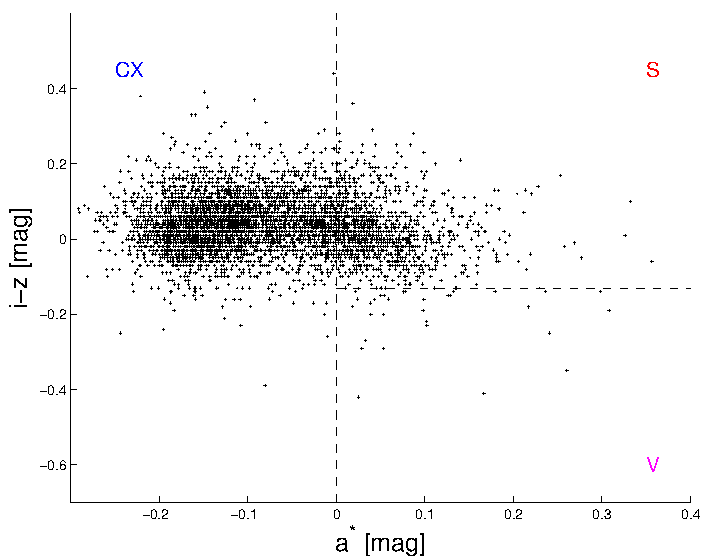
An (a*,i-z) projection of outer main belt asteroids in the in our multi-domain sample. |
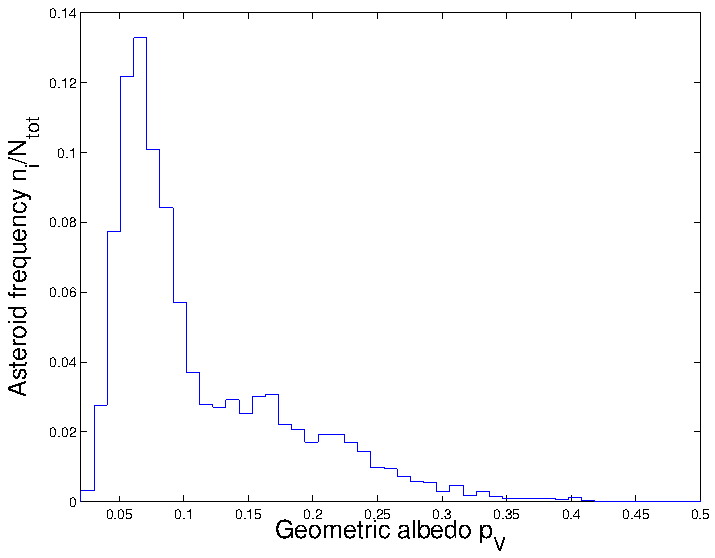
A histogram of number frequency values ni/NTot as a function of geometric albedo pV for outer main belt asteroids in our multi-domain sample. |
| First halo member |
dmd [m/s] |
Number of members |
Spectral complex |
Number of SDSS-MOC4 interlopers |
Number of albedo interlopers |
| (158) Koronis: (761) |
215 |
200 |
S |
32 |
14 |
| (18405) 1993 FY12: (29959) |
355 |
2 |
CX |
0 |
1 |
| (10811) Lau: (51707) |
490 |
10 |
CX |
0 |
0 |
| (709) Fingella: (1337) |
480 |
16 |
CX |
0 |
0 |
| (845) Naema: (21257) |
390 |
43 |
CX |
0 |
0 |
| (293) Brasilia: (3985) |
440 |
24 |
CX |
3 |
17 |
| (24) Themis: (981) |
310 |
700 |
CX |
9 |
50 |
| (221) Eos: (320) |
165 |
738 |
S |
379 |
132 |
| (10) Hygiea: (867) |
290 |
426 |
CX |
6 |
36 |
| (283) Emma: (3369) |
270 |
43 |
CX |
0 |
0 |
| (490) Veritas: (5592) |
240 |
148 |
CX |
2 |
9 |
| (3556) Lixiaohua: (18477) |
255 |
69 |
CX |
1 |
0 |
| (96) Aegle: (29579) |
290 |
21 |
CX |
2 |
0 |
| (137) Meliboea: (1165) |
270 |
73 |
CX |
3 |
1 |
| (1040) Klumpkea/Tirela: (18399) |
290 |
21 |
CX |
2 |
0 |
| (778) Theobalda: (3432) |
310 |
34 |
CX |
0 |
2 |
| (781) Kartivelia: (11911) |
280 |
26 |
CX |
1 |
0 |
| (702) Alauda/Luthera: (11911) |
420 |
158 |
CX |
2 |
19 |
| (31) Euphrosyne: (16712) |
575 |
75 |
CX |
0 |
3 |